
Cash handling at the counter
Cash Drawers for Small Businesses
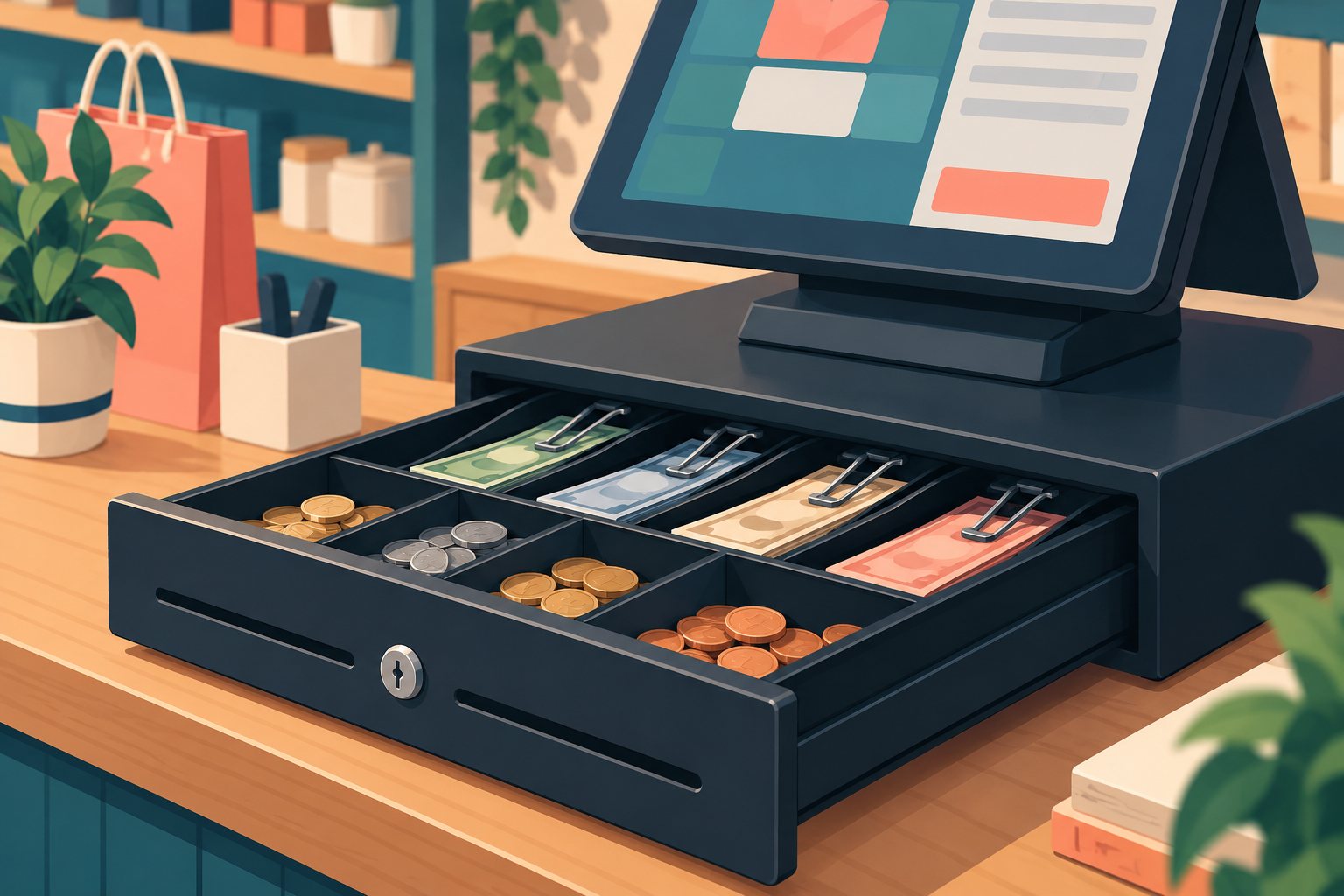
Does every small business need a cash drawer? Not necessarily. A genuinely cashless operation may have no routine need for one. But if your business accepts notes and coins at the counter, you need a deliberate way to receive cash, organize change, control access and reconcile what remains afterwards. For many businesses, a suitable cash drawer forms part of that process — but the hardware only works well when the routine around it is clear.
Does every small business actually need one?
No. The answer depends on how the business takes payment.
If you operate without accepting physical cash, buying a drawer simply because tills traditionally have one may add equipment you do not use. If you regularly accept cash and give change, however, a purpose-designed drawer can give staff an organized place to handle that part of the transaction.
Start with your payment journey
Ask how often customers pay with cash, who accepts it and where the transaction happens. Then consider how notes and coins are held during service, how change is given and how the amount is checked later.
A market stall taking occasional cash has a different requirement from a busy café counter processing cash transactions throughout the day. Choose around the real operation rather than the idea that every small business must own identical hardware.
“The important decision is not whether a cash drawer looks like standard till equipment. It is whether it supports the way your business actually handles cash.”
What a cash drawer contributes at the counter
At its simplest, a cash drawer gives notes and coins defined compartments at the point of sale. That makes the physical side of a cash transaction easier to organize.
It does not, by itself, guarantee accurate records, prevent every mistake or eliminate loss. Those outcomes depend on the wider cash-handling process and the people following it.
Consider a busy transaction
Hypothetical example: a customer pays for a £13.40 purchase with a £20 note while another customer is already waiting. The staff member needs to record the sale through the business’s normal process, place the received cash correctly and return the right change.
A consistently organized drawer makes the physical part of that sequence easier to follow. If every denomination is mixed together or staff use different layouts, the same transaction demands more searching and checking.
Organization is only useful when everybody understands it
Agree a drawer layout for your business rather than allowing each shift to rearrange it. The exact arrangement can reflect the denominations you commonly handle and the design of the drawer.
Keep non-cash clutter out of compartments needed for transactions. Receipts, handwritten notes and miscellaneous keys can quickly turn an organized working area into a rummage box.

Plan the transaction before choosing the drawer
The drawer is one component of a service point. Before selecting it, look at what happens around it.
Where does the member of staff enter the sale? Where does the customer stand? Where is cash received? Where is change counted? Does a drawer opening interfere with another colleague, a cupboard or the customer handover area?
The drawer needs working clearance
A model may fit underneath the counter while closed and still be unsuitable if it cannot open fully in the proposed position.
Use the dimensions and installation requirements for the actual hardware being considered. Include any mounting or connection arrangements specified for that setup and confirm them with the supplier before installation.
Think about access during the sale
Positioning should support the staff member using the till without forcing repeated awkward movements or placing the open drawer in a busy route. If several people work around the same counter, include them in the layout test.
Give staff one consistent cash routine
Hardware is much easier to manage when the transaction follows a repeatable sequence.
Receiving cash
Staff should follow the business’s agreed method for recording the transaction and handling the amount received. Avoid informal shortcuts that leave uncertainty about whether a sale has been recorded.
Giving change
Use a consistent method for checking the amount returned to the customer. Staff should not feel pressured to sacrifice accuracy simply because a queue has formed.
Closing the transaction
Once the cash exchange is complete, return notes and coins to the agreed compartments and follow the business’s normal procedure for the drawer.
Any detailed cash-security arrangements should be developed for your particular premises and operation with appropriate professional advice where required. The operational point is straightforward: everybody who uses the drawer should understand the same routine.
Keep responsibility clear between shifts
Cash becomes harder to investigate when nobody knows who was responsible for the drawer or when the amount was last checked.
Define how your business handles the beginning and end of a staff member’s responsibility for cash. That may include checking an agreed starting amount and completing an appropriate count or handover later, depending on your operation.
A vague handover creates vague answers
Hypothetical example: one team finishes at 3pm and another takes over. At closing time, the physical cash does not match what the business expected from its records.
If nobody checked the position at the shift change, the team now has a much larger period to investigate. Was the difference already present at 3pm, or did it arise afterwards?
A clear handover creates useful checkpoints. The exact process should fit the business rather than creating unnecessary administration, but responsibility should not be ambiguous.

Reconcile differences instead of guessing
At an appropriate point in your operating routine, compare the physical cash with the amount your sales records indicate should be present, taking account of the starting cash and any other legitimate movements under your process.
The exact reconciliation method depends on how your business records sales and manages cash. What matters is having an agreed method and investigating unexplained differences rather than quietly changing a number until it matches.
Look for the process break
A discrepancy does not automatically tell you why it happened. It could reflect a transaction error, incorrect change, a recording problem or another issue requiring investigation.
Start with the records available and narrow down when the difference appeared. If discrepancies repeat, review the relevant workflow and staff understanding rather than treating every occurrence as an isolated mystery.
Do not make unsupported promises about the drawer
A cash drawer does not make theft impossible, guarantee financial accuracy or automatically produce correct reporting. It is physical hardware within a broader point-of-sale and management process.
That distinction matters when buying equipment: choose it for the practical job it performs rather than claims no box of metal can deliver on its own.
Choose hardware for the setup you actually use
If a cash drawer makes sense for your business, check compatibility with the proposed EPOS or POS setup rather than assuming any drawer will work with any terminal or printer.
Ask practical questions before ordering
What are the drawer’s dimensions? How much space does it require when open? What note and coin organization does it provide? How is the proposed model intended to connect or operate with the rest of your setup? What installation requirements apply?
If you are replacing one part of an existing system, give the supplier details of the equipment you intend to retain and ask them to confirm compatibility.
Think about the counter as a whole
The drawer, terminal, printer and payment device all compete for space. Measure the complete working area and act out a transaction before fixing positions permanently.
Any electrical, mounting or other specialist installation work should follow the equipment manufacturer’s requirements and be handled by appropriately qualified people where necessary.
Build a practical cash-drawer checklist
The useful decision combines hardware and routine. Before buying or changing your setup, work through the questions below with the people who will actually use it.
| Area | Question to answer |
|---|---|
| Need | Do we routinely accept physical cash at this service point? |
| Layout | Where will the drawer sit, and can it open without obstructing normal service? |
| Compatibility | Has the supplier confirmed the proposed drawer works with our intended setup? |
| Organization | How will notes and coins be arranged consistently? |
| Access | Which staff roles use the drawer during normal trading? |
| Starting position | How do we establish and record the appropriate opening cash position? |
| Handover | When responsibility changes, how does the next person know their starting position? |
| Reconciliation | When and how do we compare physical cash with our sales records? |
| Difference | Who investigates an unexplained discrepancy and what records do they use? |
| Training | Can every authorized user demonstrate the agreed transaction and handover routine? |
Run the routine with sample transactions before relying on it during a busy shift. Include an ordinary cash sale, giving change and a staff handover. The aim is to find unclear steps while they are easy to correct.
Practical takeaway
Not every small business needs a cash drawer, but businesses that accept physical cash need a clear way to handle it. If a drawer forms part of that setup, choose one that fits the counter and is confirmed as suitable for the equipment you intend to use. Then give staff a consistent routine for transactions, responsibility changes and reconciliation. The drawer organises the cash; the process around it is what makes that organization useful.
Put the idea into practice
After deciding whether cash handling still matters to your operation, look at the drawer as one part of the complete counter rather than an isolated purchase. Cash drawers covers the dedicated component, while EPOS hardware helps you consider how it sits alongside the rest of the setup.